Saltwater Pool Maintenance Checklist
Saltwater Pool Maintenance Checklist: What to Test, When & How (2025 Expert Guide)
Saltwater pools promise “less maintenance”—but that doesn’t mean *no maintenance*. In fact, improper care can lead to corroded ladders, cloudy water, or a dead chlorinator cell—costing you hundreds in repairs.
Saltwater Pool Maintenance Checklist
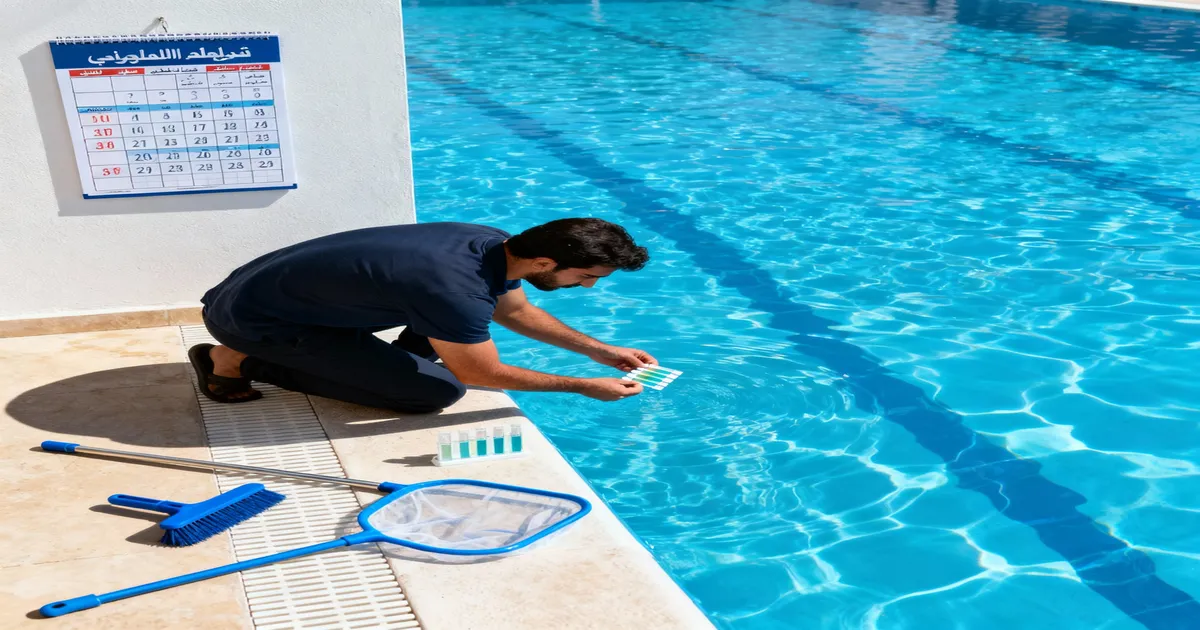
The secret to a flawless saltwater pool in 2025? A consistent, science-backed maintenance routine that balances chemistry, protects equipment, and prevents problems before they start.
In this expert guide, we break down exactly what to test, how often, and which tools to use—plus a printable monthly checklist used by professional pool technicians across the U.S. and Europe.
Why Saltwater Pools Still Need Regular Maintenance
Despite the name, saltwater pools are chlorine pools—they just generate chlorine automatically. But this system introduces unique needs:
- Salt is corrosive to metal, stone, and some pool surfaces.
- Chlorinator cells scale up if the water balance is off.
- Low salt = no sanitation; high salt = equipment damage.
Neglecting maintenance turns your “easy” pool into a high-cost headache.
Saltwater Pool Maintenance Checklist
The 5 Critical Water Parameters to Test (and Ideal Ranges for 2025)
1. Salt Level (Sodium Chloride)
- Ideal Range: 2,700 – 4,500 ppm (check your chlorinator manual)
- Test Frequency: Weekly in summer; monthly in winter
- Tool: Digital salt meter (e.g., Myron L) or test strips
- Tip: Evaporation concentrates salt—dilute with fresh water if >5,000 ppm.
2. Free Chlorine (FC)
- Ideal Range: 1 – 3 ppm
- Test Frequency: 2–3 times/week
- Tool: DPD test kit (liquid drops, not strips)
- Warning: If FC = 0, your chlorinator may be off or scaled.
3. pH Level
- Ideal Range: 7.2 – 7.6
- Why it matters: High pH causes scale on chlorinator cells; low pH corrodes metal.
- Test Frequency: 2–3 times/week
- Adjust with: Muriatic acid (to lower), soda ash (to raise)
4. Total Alkalinity (TA)
- Ideal Range: 60 – 80 ppm (lower than chlorine pools!)
- Role: Stabilizes pH. Too high → pH drifts up → scaling.
- Test Frequency: Weekly
- Adjust with: Dry acid (to lower), baking soda (to raise)
5. Cyanuric Acid (CYA / Stabilizer)
- Ideal Range: 30 – 50 ppm
- Caution: Salt systems don’t add CYA—you must add it manually.
- Test Frequency: Monthly
- If CYA > 80 ppm: Partial drain/refill needed (chlorine becomes ineffective).
Saltwater Pool Maintenance Checklist
Monthly Maintenance Checklist (Printable)
| Task | Frequency | Notes |
|---|---|---|
| Test salt, chlorine, pH, TA | 2–3x/week | Use a liquid test kit for accuracy |
| Inspect the chlorinator cell | Monthly | Look for white scale buildup |
| Clean chlorinator cell (if needed) | As required | Soak in 4:1 water/vinegar or acid wash |
| Check salt level | Weekly (summer), Monthly (winter) | Add salt only if <2,700 ppm |
| Test CYA | Monthly | Add stabilizer if <30 ppm |
| Inspect metal fixtures | Monthly | Look for green corrosion (install zinc anode if needed) |
| Rinse the pool deck | Weekly | Prevents salt residue etching of stone/pavers |
How to Clean Your Salt Cell (Step-by-Step)
A scaled cell reduces chlorine production by up to 80%. Clean it when you see white crust:
- Turn off the power to the chlorinator.
- Remove the cell from the plumbing.
- Mix 1 part muriatic acid with 4 parts water (or use vinegar for light scale).
- Soak the cell for 10–15 minutes (do not exceed 20 mins).
- Rinse thoroughly with fresh water.
- Reinstall and power on.
⚠️ Never use a brush or metal tool—scratches damage the titanium plates.
Saltwater Pool Maintenance Checklist
Protecting Your Equipment from Salt Corrosion
- Install a zinc anode: A Sacrificial rod that corrodes instead of your ladder or light rings. Replace annually.
- Use salt-rated fixtures: Look for “saltwater compatible” on ladders, lights, and heaters.
- Rinse after heavy use: Hose down deck and equipment weekly.
- Avoid salt shock: Never add more than 10 lbs of salt at once—dissolve first in a bucket.
Seasonal Adjustments for 2025
Summer (High Use, Hot Weather)
- Run chlorinator 8–12 hours/day
- Test water 3x/week
- Watch for salt concentration due to evaporation
Winter (Low Use, Cold Weather)
- Most chlorinators shut off below 60°F (15°C)
- Switch to manual chlorine tablets
- Keep the salt level at 3,000 ppm to prevent freeze damage to the cell
Top 3 Testing Tools for Saltwater Pools (2025)
1. Taylor K-1766 Saltwater Test Kit
The gold standard. Tests chlorine, pH, TA, CYA, and salt with lab-grade accuracy.
2. AquaChek 7-Way Test Strips
Fast and decent for weekly checks—but verify with the liquid kit if readings seem off.
3. Myron L Ultrameter II
Digital handheld meter that measures salt, pH, and ORP in seconds. Pricey ($300) but worth it for serious owners.
Saltwater Pool Maintenance Checklist
Frequently Asked Questions (FAQ)
Can I use regular chlorine test kits?
Yes—but ensure it measures free chlorine, not total chlorine. Salt pools don’t use combined chlorine.
Why is my water cloudy even with perfect chemistry?
Most likely: dirty filter or low circulation. Clean filter and run pump 8+ hours/day.
How often should I replace the salt cell?
Every 3–7 years, depending on usage and water balance. Signs of failure: no chlorine production despite high salt.
Do I need to add stabilizer (CYA) to a saltwater pool?
Yes! Salt systems produce chlorine but not CYA. Without it, sunlight destroys chlorine in hours.
Final Recommendation
A saltwater pool is low-maintenance only if you stay consistent. Follow this checklist, invest in a good test kit, and inspect your cell monthly—you’ll enjoy crystal-clear water with minimal effort all season long.
At YAHYA STORE, we offer premium salt cells, zinc anodes, and 2025’s most accurate test kits—backed by expert support for U.S. and European pool owners.
Don’t guess—test. Your pool (and wallet) will thank you.
Saltwater Pool Maintenance Checklist